Your home holds more than you remember.
Just tell your AI — Home Memory never forgets.
Cable routes forgotten after drywall. The exact paint you used two years ago? Can't read it off the wall. Serial numbers, service dates — somewhere.
And even when you tried, not everything worth remembering felt worth the effort. That's why most home documentation dies. You only find out when it's too late.
Home Memory gives your AI structured, persistent memory about your home. No forms, no navigation. Just talk. The AI reads and writes your home data for you, and often figures out what you didn't say. Like a colleague who thinks ahead. The more your AI knows about your home, the better it can help you decide.
Not just recall. Your AI can help you think, compare, and decide.
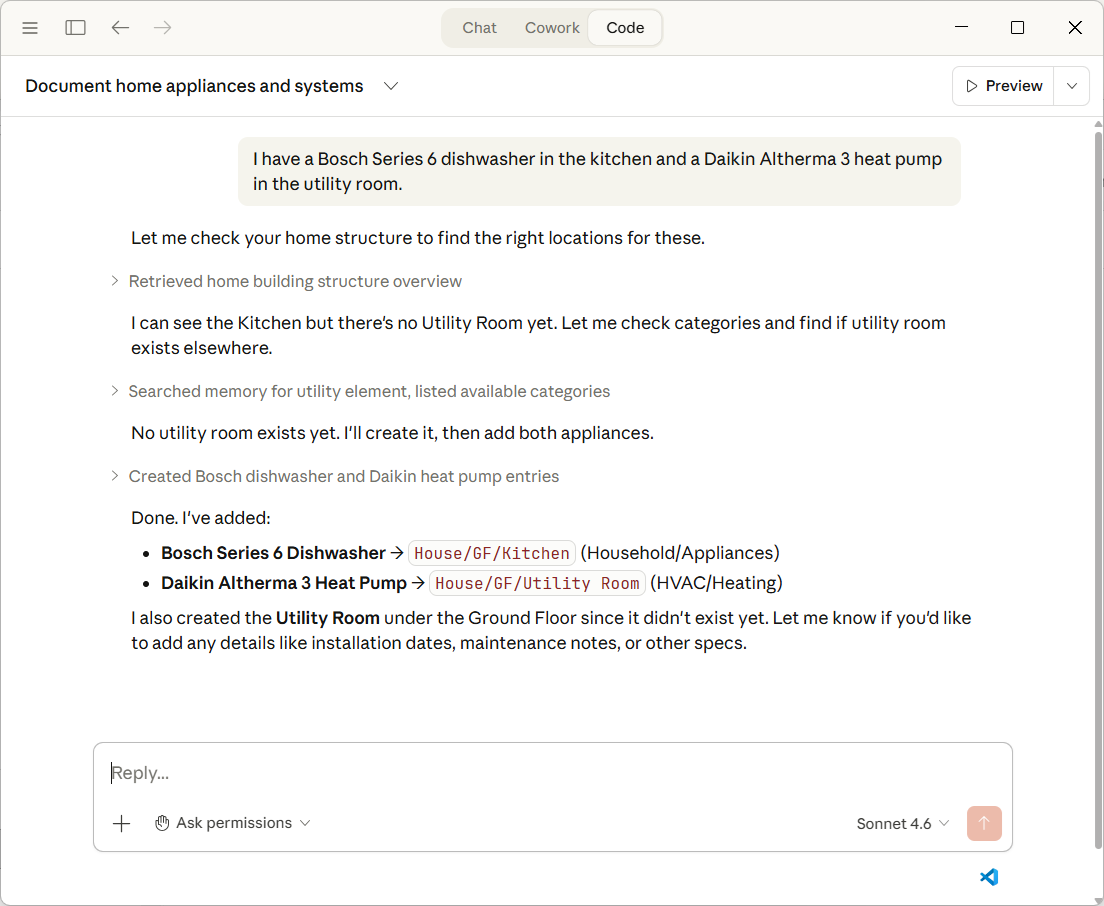
One sentence. Two appliances documented, utility room created, all in the right place.
Install Home Memory on your machine. Self-contained on Windows. macOS and Linux: build from source.
Claude Desktop, Claude Code, Codex, or any MCP-compatible client. MCP is an open standard for connecting AI to external tools.
Ask questions, add devices, track connections, all in natural language.
Track cables, pipes, and ducts — and where they run.
Start with whatever matters most to you. There's no need to document everything. The value grows with every entry.
Anyone who cares about their home, whether you're documenting every circuit, cable, and pipe in the house or just want to remember what's stored in the attic and when the boiler or car was last serviced.
When I built my house, I wrote software to plan and document the whole thing: outlets, conduits, circuits, pipe runs. Over time it grew: HVAC, vehicles, tools, even trees in the garden. Having that data came in handy more often than I expected. But adding data was always the bottleneck.
When MCP came along, I connected that database to an AI assistant, and the bottleneck disappeared. That's Home Memory.
Your data isn't trapped in a chat. It lives in a structured, local database file.